Forensic Search Dogs
to Locate Body Fluids or Crime Scenes
This is an extremely new phenomena in the dog world and here at
Dog Detectives we are pleased to have the pioneer in this field
as a member of highly skilled staff. He has lectured at seminars
around the world and currently is engaged in several high profile
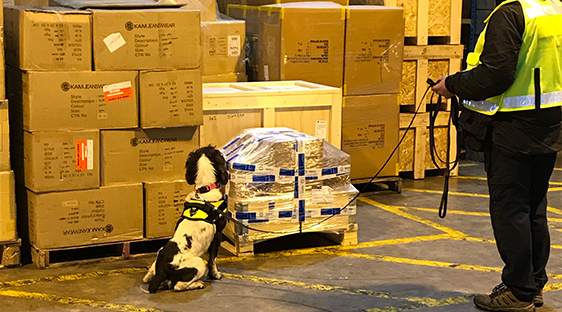
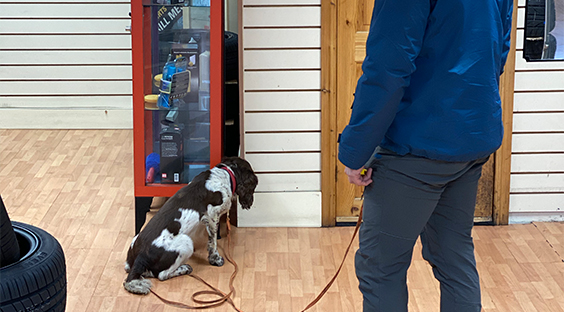
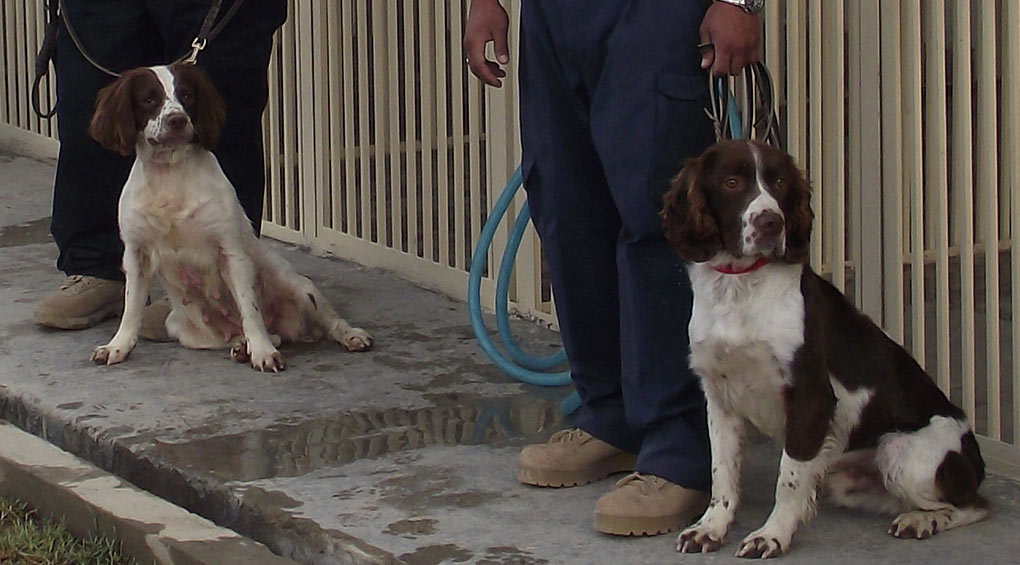
projects. Dogs that have been specially trained to locate blood
and/or semen can assist other more recognised techniques in the
search for vital evidence at the scene of a crime.
These dogs are especially effective when the actual scene is
not known as they can quickly eliminate innocent areas. At present
the only effective way to locate blood residue is by the use
of luminol. The Crime Scene Investigator (CSI) sprays the area
to be searched with luminol. This reacts with the haemoglobin
in the blood to cause a reaction known as chemiluminescence.
In short, this reaction causes the blood residue to glow when
ultra violet light is shone on it.
In order to achieve this effect the area must be completely
blacked out. This process has several drawbacks, firstly the
CSI has to spray the correct area thoroughly and then the residue
must be within line of sight of the operator. In addition the
fact the area has to be in complete darkness precludes exterior
searches.
The whole process is costly in terms of time and expense. Luminol
also has other limitations in that it can destroy other vital
evidence and innocent substances, such as household bleach can
give the "false positives". In this respect a specially
trained dog provides the solution.
Because the dog searches an area three dimensionally and only
targets a specific scent it is able to eliminate "false
positive" indications The search for semen presents the
CSI with the same problems as the search for blood. At present
semen is detected by using "black light".
Semen contains a phosphorus element which glows when subjected
to "black light". This is the same principle as a
white shirt glowing in a disco. However, like with blood, other
innocent substances such as a highlighter pen mark, also give
the same reaction.
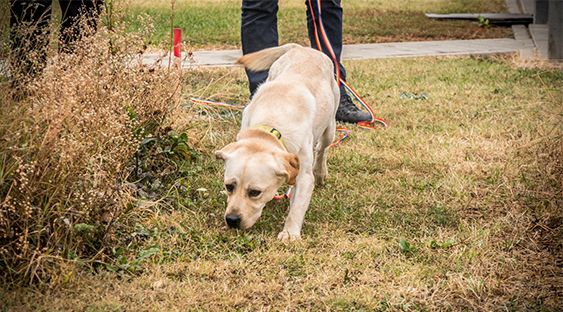
The use of trained dogs provides the investigator with the
ultimate search tool. Dogs are able to search any area, interior
or exterior (not available using existing search methods) and
are able to provide pinpoint accuracy thus enabling the CSI
to use their skills in recovering the samples.